
Transport Hub
Moderé un Design Sprint de 5 fases con 9 personas; salió un portal que hoy ahorra minutos en cada reserva.
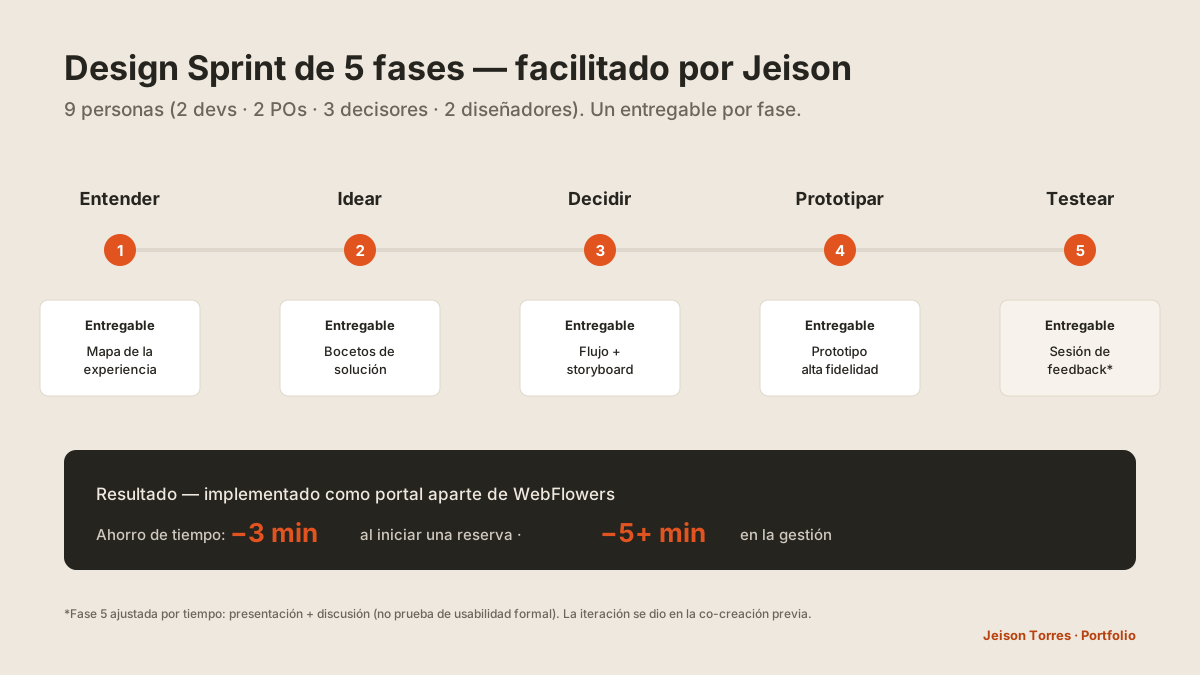
Design Sprint de 5 fases que facilité con 9 personas (desarrollo, POs, decisores) · −3/−5 min por comparación de tarea: flujo anterior (doble ventana + Excel con macros) vs. el portal.

El problema
Diseñar el flujo de reservas de transporte de exportación era cross-funcional y ambiguo: clientes, POs, reglas de negocio, destinos y estados del envío. El riesgo era diseñar pantallas sin alineación y descubrir tarde que no reflejaban el proceso ni las necesidades de los decisores.
Mi rol · equipo · organización
Facilité y moderé las 5 fases del sprint: diseñé la agenda y los ejercicios, guié las decisiones y sinteticé cada entregable; fui uno de los 2 diseñadores del equipo.
2 desarrolladores, 2 product owners, 3 clientes/decisores y el otro diseñador participaron en cada sesión y en la construcción de la solución.
GHT convocó a los decisores/clientes y definió el contexto de negocio de la exportación.
Research
Design Sprint (GV) de 5 fases — Entender · Idear · Decidir · Prototipar · Testear — con un entregable por fase.
- El mapa de la experiencia reveló los pasos reales del proceso y sus "¿cómo podríamos?".
- Las demos rápidas trajeron referentes dentro y fuera del dominio para inspirar soluciones.
- La fase de test se ajustó a presentación + discusión: al co-construir con usuarios y decisores desde antes, la iteración ya había ocurrido en el proceso.
Entender → mapa de experiencia. Idear → bocetos de solución (Crazy 8s). Decidir → flujo de usuario + storyboard, con voto de los decisores. Prototipar → prototipo de alta fidelidad. Testear → sesión de retroalimentación con usuarios y decisores.
Insights
- Facilitar es diseñar el proceso de decisión, no solo la interfaz.
- Co-crear con decisores desde el inicio evita rediseños políticos después.
- Recortar alcance con criterio (se descartó el módulo de inspección/USDA) es una decisión de producto madura.
Evidencia visual
Del sprint al producto
Decisiones de diseño
Nueva reserva unificada
Seleccionar TSP, tipo de reserva (Flowers/Others), buscar POs y agregar cargas con dimensiones, cubos y pallets; consolidar varias POs en una reserva o cargar por plantilla.
Gestión y seguimiento en una vista
Lista filtrable por reserva, fechas, empresa, origen/destino y estado (Finished / Pending / On truck), con totales de cajas/cubos/pallets.
Resultados
Aprendizajes
- Facilitar es diseñar el proceso de decisión, no solo la interfaz.
- El tiempo del test se protege desde la agenda.
- La decisión compartida acelera: el voto de los decisores evitó rediseños políticos.
Transport Hub
I moderated a 5-phase Design Sprint with 9 people; it produced a portal that now saves minutes on every booking.
5-phase Design Sprint I facilitated with 9 people (devs, POs, decision-makers) · −3/−5 min by task comparison: prior flow (two windows + Excel macros) vs. the portal.
The problem
Designing the export transport booking flow was cross-functional and ambiguous: customers, POs, business rules, destinations and shipment statuses. The risk was designing screens without alignment and discovering too late that they reflected neither the process nor the needs of the decision-makers.
My role · team · organization
I facilitated and moderated the 5 phases of the sprint: I designed the agenda and exercises, guided decisions and synthesized each deliverable; I was one of the 2 designers on the team.
2 developers, 2 product owners, 3 customers/decision-makers and the other designer took part in every session and in building the solution.
GHT convened the decision-makers/customers and defined the business context of the export operation.
Research
5-phase Design Sprint (GV) — Understand · Ideate · Decide · Prototype · Test — with one deliverable per phase.
- The experience map revealed the real steps of the process and their "How might we…?" questions.
- Quick demos brought references from inside and outside the domain to inspire solutions.
- The test phase was adjusted to presentation + discussion: by co-building with users and decision-makers from the start, iteration had already happened during the process.
Understand → experience map. Ideate → solution sketches (Crazy 8s). Decide → user flow + storyboard, with the decision-makers voting. Prototype → high-fidelity prototype. Test → feedback session with users and decision-makers.
Insights
- Facilitating is designing the decision process, not just the interface.
- Co-creating with decision-makers from the start avoids political redesigns later.
- Cutting scope with judgment (the inspection/USDA module was dropped) is a mature product decision.
Visual evidence
From sprint to product
Design decisions
Unified new booking
Select the TSP and booking type (Flowers/Others), search POs and add loads with dimensions, cubes and pallets; consolidate several POs into one booking or load from a template.
Management and tracking in one view
Filterable list by booking, dates, company, origin/destination and status (Finished / Pending / On truck), with totals of boxes/cubes/pallets.
Results
Learnings
- Facilitating is designing the decision process, not just the interface.
- Test time is protected from the agenda.
- Shared decisions speed things up: the decision-makers' vote avoided political redesigns.